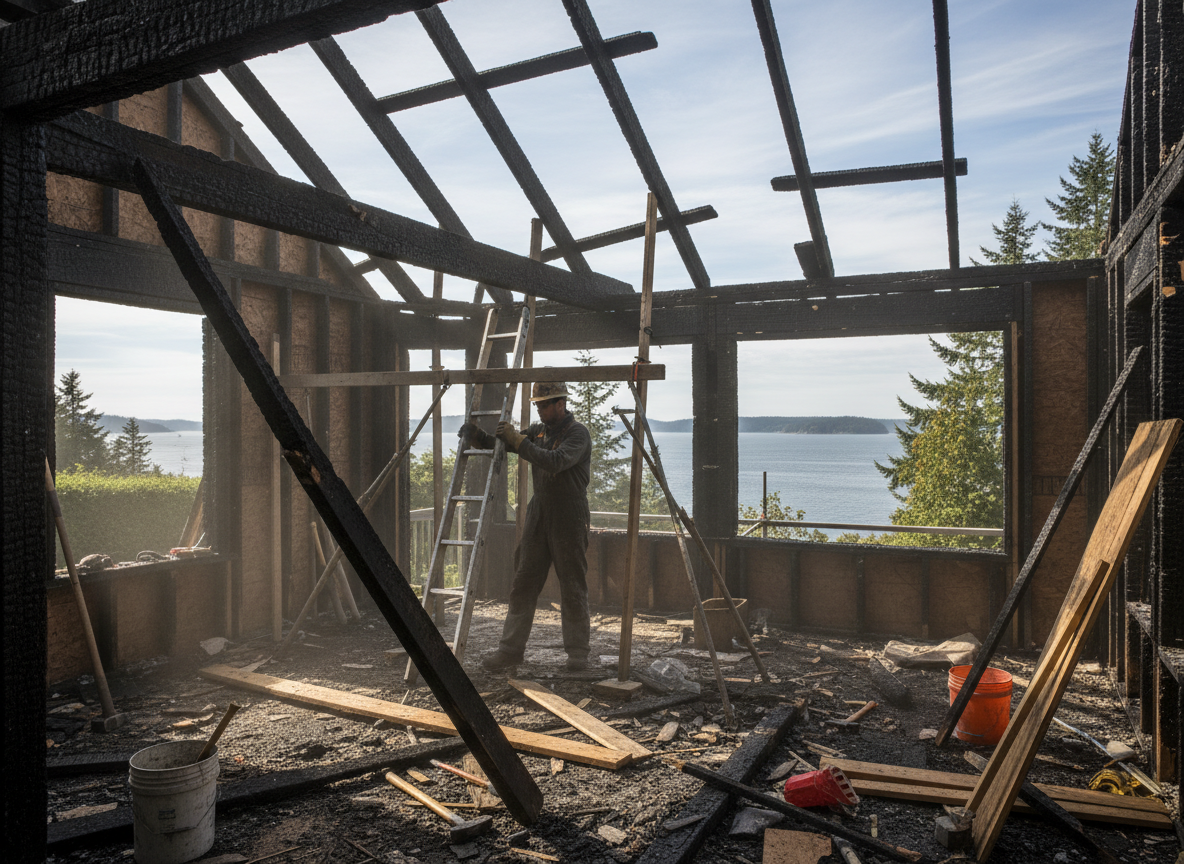
Fires in Island County often leave behind compromised joists and sheathing in homes built before the 1980s, especially the cedar-framed houses common around Camano City and Madrona Beach. Wet winters accelerate hidden rot where smoke residue meets moisture trapped behind walls, so repairs must address both char and subsequent water intrusion before drywall or siding goes back on. Near Camano Island State Park and Cama Beach State Park, access roads can narrow quickly, requiring crews to stage materials carefully to avoid damaging driveways or sensitive slopes.
After initial demolition, replacement lumber must match existing dimensions and species to satisfy Island County building requirements, particularly when load paths run through older post-and-beam construction found in Utsalady. Dry summers reduce the immediate risk of new water damage during the repair window, yet crews still install temporary weather barriers because sudden marine moisture can arrive without warning. Smoke odor can migrate through shared attic spaces between neighboring properties, so sealing and ventilation work often extends beyond the primary fire room.
When structural members run parallel to the shoreline, salt air has already corroded fasteners in many Madrona Beach homes; fire damage then makes those connections fail faster. Replacement includes stainless or coated hardware rated for marine exposure and proper nailing schedules to restore shear strength. Final inspections focus on concealed spaces where embers may have traveled along insulation, a step that prevents callbacks once finishes are installed.
Technician insight
In Camano Island, the thing that catches most people out with structural repair after fire is how quickly our wet winters turn light smoke residue into active rot inside cedar walls, especially in the older Utsalady homes where original posts sit directly on soil. Homeowners often assume once the fire is out the structure is stable, but the marine climate keeps pushing moisture back into any unsealed cavity for months afterward.
Charred Beam Replacement in Camano City
A kitchen fire had traveled up through a wall and compromised a main floor joist in a 1970s cedar home near Camano City. Inspection showed the joist end had burned through where it met a damp crawlspace, and winter rain had already begun softening the surrounding rim board. We shored the floor, replaced the joist and rim section with pressure-treated lumber and stainless connectors rated for coastal exposure, then sealed and dried the cavity before closing it in.
How it works
- 1
Initial Assessment
Technicians document visible char, test for hidden extension along floor and roof systems, and note any pre-existing moisture from Camano's wet winters.
- 2
Stabilization
Temporary shoring is installed where needed to keep the structure safe while debris is removed and the site is protected from further rain.
- 3
Selective Demolition and Drying
Damaged sections are cut out, affected cavities are dried with equipment suited to marine humidity, and materials are staged for disposal.
- 4
Structural Replacement
New framing, sheathing, and connections are installed to match original construction, using hardware appropriate for Island County coastal conditions.
- 5
Finishing and Verification
Repairs are closed in, surfaces are prepared for other trades, and final walkthrough confirms load paths and weather barriers meet code.
Pricing
Cost depends on the number of load-bearing members replaced, access difficulty on sloped lots, and whether winter moisture requires additional drying time.