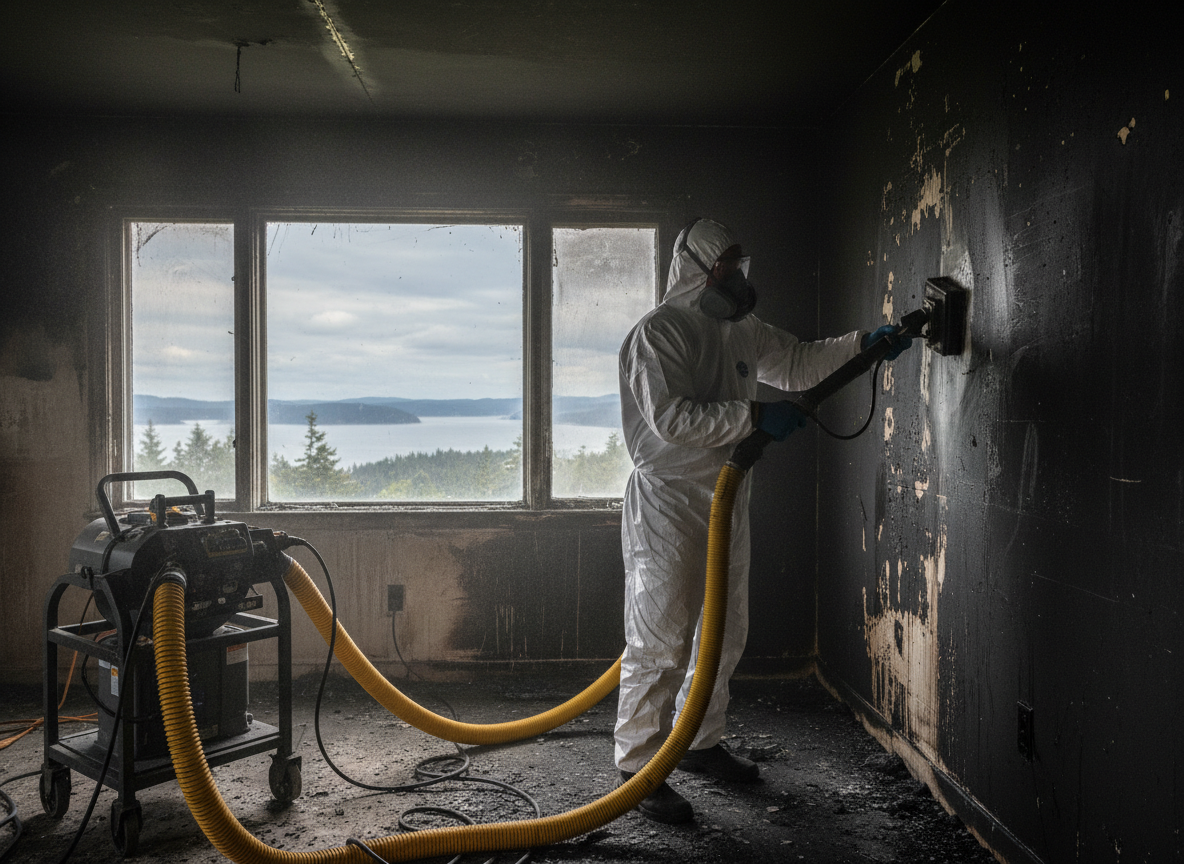
Camano Island homes built before the 1980s often feature cedar siding and fir floors that readily absorb acidic smoke particles carried by the mild marine air. When winter rains follow a fire, those residues turn corrosive and migrate deeper into framing and insulation, especially in neighborhoods like Utsalady where wind funnels smoke from nearby burns. Standard surface cleaning fails here; technicians must test pH levels on multiple substrates and use specialized rinses to neutralize residues before they etch metal fixtures or discolor plaster.
Dry summers increase the risk of hidden smoke migration through attics and crawl spaces common on the island's rolling terrain. Soot travels upward with rising heat and settles in insulation batts that are difficult to access without disturbing the vapor barrier. In homes near Cama Beach State Park, salt air already present in the environment combines with combustion byproducts to accelerate corrosion on wiring and HVAC coils, requiring component-by-component inspection rather than blanket replacement assumptions.
Restoration crews working from the 370 NE Camano Dr base prioritize negative-air containment to keep loosened particles from drifting into unaffected rooms during the wet season. Odor removal follows only after particulate clearance, because residual moisture from Island County winters can reactivate smells days later if thermal fogging or hydroxyl units are applied too soon. Homeowners in Camano City frequently discover that reopened windows and doors reintroduce outdoor humidity that re-soils freshly cleaned surfaces.
Electrical systems in Madrona Beach cottages often run through knob-and-tube wiring that traps soot inside junction boxes. Removing this requires de-energizing circuits and vacuuming each box individually rather than relying on whole-house air scrubbers alone. Failure to address these pockets leaves persistent odors and creates future corrosion points once the marine dampness returns.
Technician insight
In Camano Island, the thing that catches most people out with Smoke damage restoration is how wet winters let acidic residues sink deeper into the cedar siding and fir floors found in Utsalady and Madrona Beach homes; homeowners often try wiping surfaces themselves and only push the soot farther into the grain before we arrive.
Attic soot migration after fireplace malfunction
A Camano City residence near Cama Beach State Park experienced smoke traveling through an unsealed attic chase during a winter storm. Inspection revealed acidic particles had settled into insulation batts and along knob-and-tube wiring runs. Crews isolated the attic, removed contaminated insulation, neutralized framing, and treated the HVAC before reinstalling new insulation and confirming clearance once humidity dropped.
How it works
- 1
Initial Assessment
Technicians document smoke travel paths through the home, test surfaces for pH, and map affected HVAC runs while noting proximity to Camano Island State Park terrain that can channel wind-driven soot.
- 2
Containment and Source Removal
Plastic barriers and negative air machines isolate rooms; loose debris and charred materials are removed first to prevent further particle spread during wet weather.
- 3
Deep Cleaning and Neutralization
HEPA vacuums and pH-adjusted solutions clean wood, plaster, and metal; multiple passes address residues that have penetrated older fir and cedar common in Utsalady homes.
- 4
Odor Elimination and Drying
Hydroxyl generators or fogging treat remaining smells only after moisture levels are verified, preventing reactivation during Island County's frequent winter rains.
- 5
Final Clearance and Monitoring
Air sampling and surface checks confirm no re-soiling risk before returning contents; follow-up visits account for humidity changes near Stanwood and Arlington.
Pricing
Cost depends on square footage affected, depth of soot in older wood structures, and whether HVAC or electrical components require component-level work.