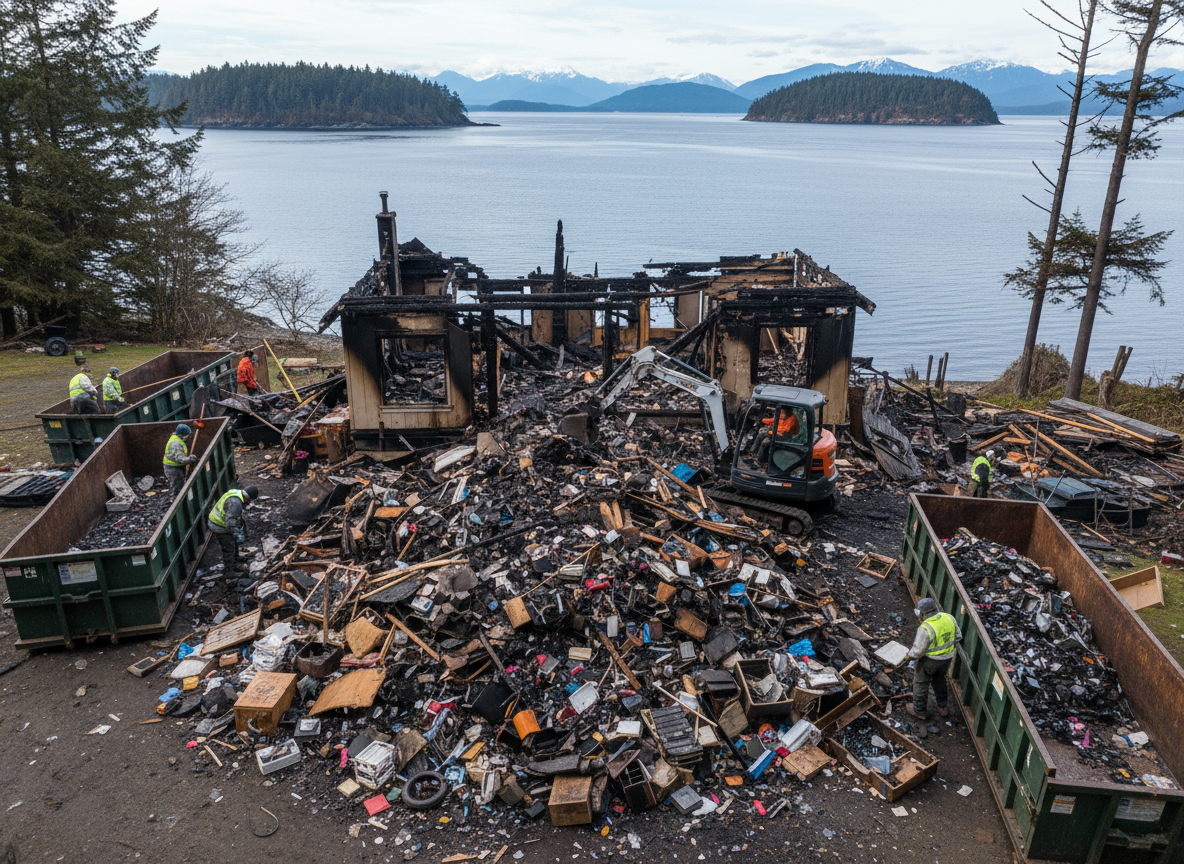
Hoarding cleanup after fire on Camano Island often involves older single-story homes built before the 1980s that sit on septic systems and lack modern ventilation. Smoke and soot settle into stacked newspapers, clothing and furniture, creating hidden reservoirs that release odors weeks later when winter rains raise indoor humidity. Crews must separate charred items from salvageable ones while wearing full PPE because disturbed debris can aerosolize particulates into living spaces near Camano Island State Park.
Wet winters followed by dry summers change the job sequence. Moisture from Island County storms can wick into hoarded materials against exterior walls in Camano City, promoting bacterial growth that fire alone would not trigger. Technicians document every layer removed so homeowners and insurers see the actual volume and contamination levels before final clearance testing.
Edge cases appear around Madrona Beach where homes sit on sloped lots. Ash and water runoff can carry contaminants downslope into crawl spaces or neighboring properties, requiring containment barriers before debris leaves the site. All waste is tracked to approved Island County disposal facilities rather than mixed with standard construction debris.
Coordination with Stanwood and Arlington suppliers ensures replacement materials match the modest scale of local homes without over-ordering. Work stops only after air sampling confirms particulates have returned to background levels typical for the marine climate.
Technician insight
In Camano Island, the thing that catches most people out with hoarding cleanup after fire is how older homes in Camano City trap soot between stacked boxes and exterior walls that never fully dry during our mild but wet winters, so the odor returns the first time humidity spikes again.
Madrona Beach Fire and Hoard Job
A kitchen fire spread soot into a Camano City home packed with decades of stored items. We found water from suppression efforts had wicked into cardboard against the north wall, creating hidden mold. Crews removed layers in sections, contained runoff on the sloped lot, and completed odor neutralization before final testing cleared the space.
How it works
- 1
Initial Assessment and Safety Walk
Technician inspects the property in Utsalady or Madrona Beach, identifies structural risks, documents hoarded volume and notes any water intrusion from recent rains.
- 2
Containment and Air Scrubbing Setup
Negative air machines and plastic barriers isolate the work zone to prevent soot migration into unaffected rooms before any items are touched.
- 3
Layered Removal and Sorting
Items are removed in sections, separated into salvage, contaminated and hazardous categories, with every step photographed for insurance records.
- 4
Deep Cleaning and Odor Neutralization
Surfaces receive HEPA vacuuming, chemical cleaning and hydroxyl treatment to address embedded smoke residue in older wood and drywall.
- 5
Final Clearance and Disposal
Air sampling confirms safe levels, debris is hauled to approved Island County sites, and the home is returned for reconstruction.
Pricing
Cost depends on cubic volume of hoarded material, fire damage depth and whether hidden moisture from wet winters is present; upfront written quotes provided after on-site assessment.