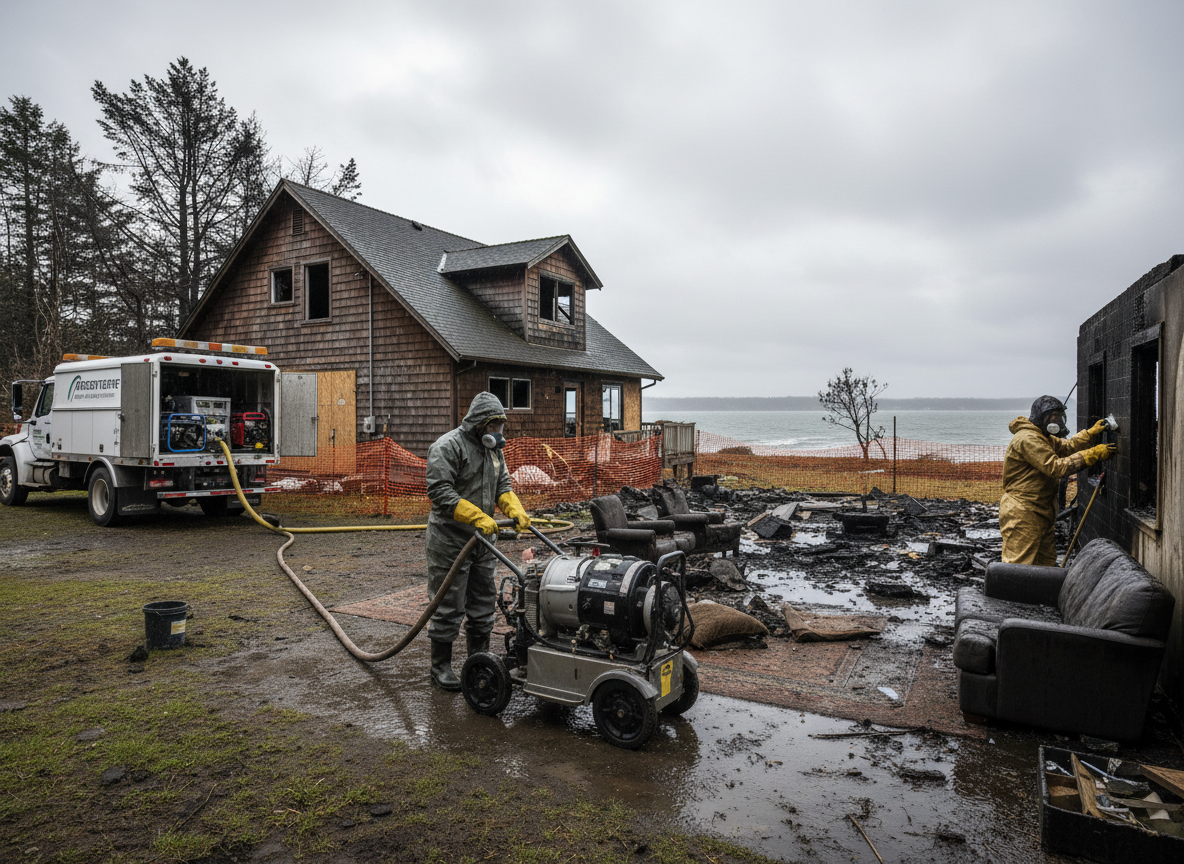
Camano Island homes, especially those in Utsalady and Camano City built before modern codes, often combine older wood framing with limited crawlspace ventilation. After a fire, soot migrates into these voids while the mild marine climate's wet winters push residual moisture into the same cavities, creating hidden mold growth within weeks. Crews must pull baseboards and drill inspection holes early rather than relying on surface cleaning alone.
Flood events tied to heavy winter rains frequently follow fire damage because charred roofs and siding lose their water-shedding ability. Properties near Cama Beach State Park and Madrona Beach sit on slopes where runoff concentrates against foundations; when fire residue mixes with this water it produces acidic staining on concrete that standard cleaners cannot remove. Extraction and drying must therefore run concurrently with soot removal to prevent permanent discoloration.
Island County permitting requires documentation of both fire and water damage before re-occupancy, and Stanwood and Arlington suppliers often delay delivery of specialty drying equipment during peak storm season. Local crews keep portable generators and extra dehumidifiers staged at the 370 NE Camano Dr shop to avoid multi-day waits that allow secondary damage to accelerate in the damp climate.
Dry summers reduce immediate water risk but increase the chance that wind-driven embers from nearby fires ignite vegetation around older shake-roof homes. Restoration then includes clearing scorched landscaping and treating soil for hydrocarbon residue before new plantings, a step many mainland crews overlook on Camano Island jobs.
Technician insight
In Camano Island, the thing that catches most people out with Fire and flood restoration is how quickly winter rain soaks through fire-damaged roof sheathing on older homes in Utsalady and Madrona Beach. The marine climate keeps the wood damp for months, so you end up chasing moisture that migrated behind charred siding long after the fire is out.
Camano City Home After Kitchen Fire and Subsequent Rain
A kitchen fire left heavy soot throughout a single-story home in Camano City. Two days later heavy rain entered through the damaged roof and pooled in the crawlspace. Crews extracted water, dried the subfloor, removed affected insulation, and treated acidic staining on the concrete before rebuilding the ceiling and walls.
How it works
- 1
Initial Assessment
Technicians arrive within hours, document fire and water damage, and test for hidden moisture in attics and crawlspaces typical of Camano Island construction.
- 2
Containment and Extraction
Negative air machines isolate soot while pumps and extractors remove standing water before winter rains compound the problem.
- 3
Drying and Monitoring
Industrial dehumidifiers and air movers run until moisture readings meet Island County standards, with daily logs provided to homeowners.
- 4
Cleaning and Odor Removal
HEPA vacuuming, thermal fogging, and soda-blasting address smoke residue on wood, drywall, and concrete surfaces.
- 5
Reconstruction and Final Walkthrough
Repairs restore structural integrity, followed by a final inspection confirming the home meets habitability requirements.
Pricing
Upfront written estimates provided after on-site inspection; final cost depends on extent of fire and water damage plus drying duration.